

Nvidia GeForce RTX 2070 Super vs. AMD Radeon RX 5700 XT: 2022 Update
For those of you that missed it, last week we revisited the boxing between the current-gen $400 GPUs: the Radeon RX 5700 XT and GeForce RTX 2060 Super. Since we tested them both at launch nearly seven months ago, nosotros've seen new drivers, new games and game updates, withal we found a very similar situation that can be summarized as a slight performance advantage going the mode of the Radeon GPU, to the tune of viii% faster on boilerplate at 1440p gaming.
Coming abroad from that review 2 things were articulate: many of you wanted an update betwixt the 5700 XT and the more expensive RTX 2070 Super, as well every bit the inclusion of DLSS results for the games that support the much improved DLSS 2.0. Then today nosotros're going to include both of those things.

To put things in proper perspective earlier we begin, the RTX 2070 Super is the more expensive GPU starting at around $500, while the 5700 XT comes in at $400 and upwards, making the Radeon at to the lowest degree 25% cheaper.
In improver to the 2070 Super, we've added the original RTX 2070 to the mix as many readers were also requesting this. We've tested 35 games in total for this comparison and we'll show you DLSS results for the 2060 Super, 2070 and 2070 Super in Control and Wolfenstein: Youngblood.

All tests were conducted using our Core i9-9900K GPU test system clocked at 5 GHz with 16GB of DDR4-3400 memory. We're covering 1080p and 1440p resolutions although the focus of the discussion will exist on the 1440p information. Let's get into the results…
Benchmarks
First upwards we have Telephone call of Duty: Mod Warfare. This was a clear win for the 5700 XT over the 2060 Super as it offered 22% more than frames at 1440p. Surprisingly, even when compared to the RTX 2070 Super, the 5700 XT is the superior performer, fifty-fifty if it's just by a v% margin. This is a truly impressive result for AMD given how much cheaper the Radeon GPU is.


The 2070 Super is able to pull ahead in Ghost Recon Breakpoint making it 7% faster than the 5700 XT at 1440p. Notably though, the 1% low performance in the GeForce was quite a bit better at 16% faster.

The 5700 XT and RTX 2070 Super are neck and cervix in Shadow of the Tomb Raider, delivering 87 fps on average at 1440p. The original 2070 and 2060 Super are too a friction match and it appears as though the increased clock frequency of the 2060 Super cores makes up for having less of them.

Operation was competitive in Gears 5, here the 5700 XT edged ahead at 1080p while the 2070 Super managed to push button itself into the lead at 1440p by a slim margin. This is some other championship where the Radeon GPU is able to punch in a higher place its weight class.

Moving on to Control, this is one of the games with DLSS 2.0 back up and nosotros'll check out those results presently. For at present hither is native 1080p and 1440p performance. The 5700 XT just manages to edge out the 2060 Super in Control while the 2070 Super is 16% faster at 1440p. This won't fully justify the 25% increase in toll, but perhaps enabling DLSS will aid here.

Next up we have Metro Exodus and here the 5700 XT easily beats the 2060 Super. Then much so that it'south able to friction match the 2070 Super besides. Technically the Radeon GPU performs meliorate in this title with more consistent frame time performance, for whatever reason the 2070 Super struggled to ameliorate upon the 1% low result of the standard 2070 and 2060 Super.

In Resident Evil three, the 2070 Super is able to edge out the 5700 XT beating it by a seven% margin at 1440p. Hither the 5700 XT performs closer to the 2070 Super than it does the 2060 Super, so this is remains a good consequence for AMD.

Nvidia puts upwards a much more than disarming fight in Doom Eternal, chirapsia the 5700 XT with the 2070 Super past a 21% margin.

Some other game where the 5700 XT just managed to match the 2060 Super is Fortnite using the DX12 mode. Both $400 GPUs average effectually xc fps, while the 2070 Super is 17% faster, averaging only over 100 fps.

PUBG is another game where Radeon operation is a scrap iffy, performing a tad beneath the RTX 2060 Super. Frame rates for the 5700 XT relative to the GeForce competition are much worse in this title, here the RTX 2070 Super is 21% faster.

Borderlands 3 has become an AMD special, much like what Forza Horizon 4 was for quite some fourth dimension. It'due south a major outlier in our testing but the results are accurate, The 5700 XT is a whopping 32% faster than the 2060 Super and 13% faster than the 2070 Super. Whatever optimizations were washed here, clearly they are working.

Finally, we take Battlefield V, where the 5700 XT is able to match the 2070 Super with an boilerplate of 100 fps at 1440p. This is a great showing from the $400 Radeon GPU and stellar frame rates for a championship that looks then practiced at 1440p.
Performance Breakdown
Overall you tin tell the GeForce RTX 2070 Super was faster about of the time, but because the difference in price information technology certainly looked equally though the Radeon RX 5700 XT kept holding its own. The performance breakdown graphs below have the full list of 35 games we tested.
Looking at the full 1080p information first, the Radeon GPU 5700 is 6% slower than the 2070 Super, suffering it's biggest loses in The Outer Worlds, War Thunder, Vermintide 2, Doom Eternal and PlayerUnknown'south Battlegrounds.

It'south likewise worth noting that in xv of the 35 games tested the margin was five% or less.
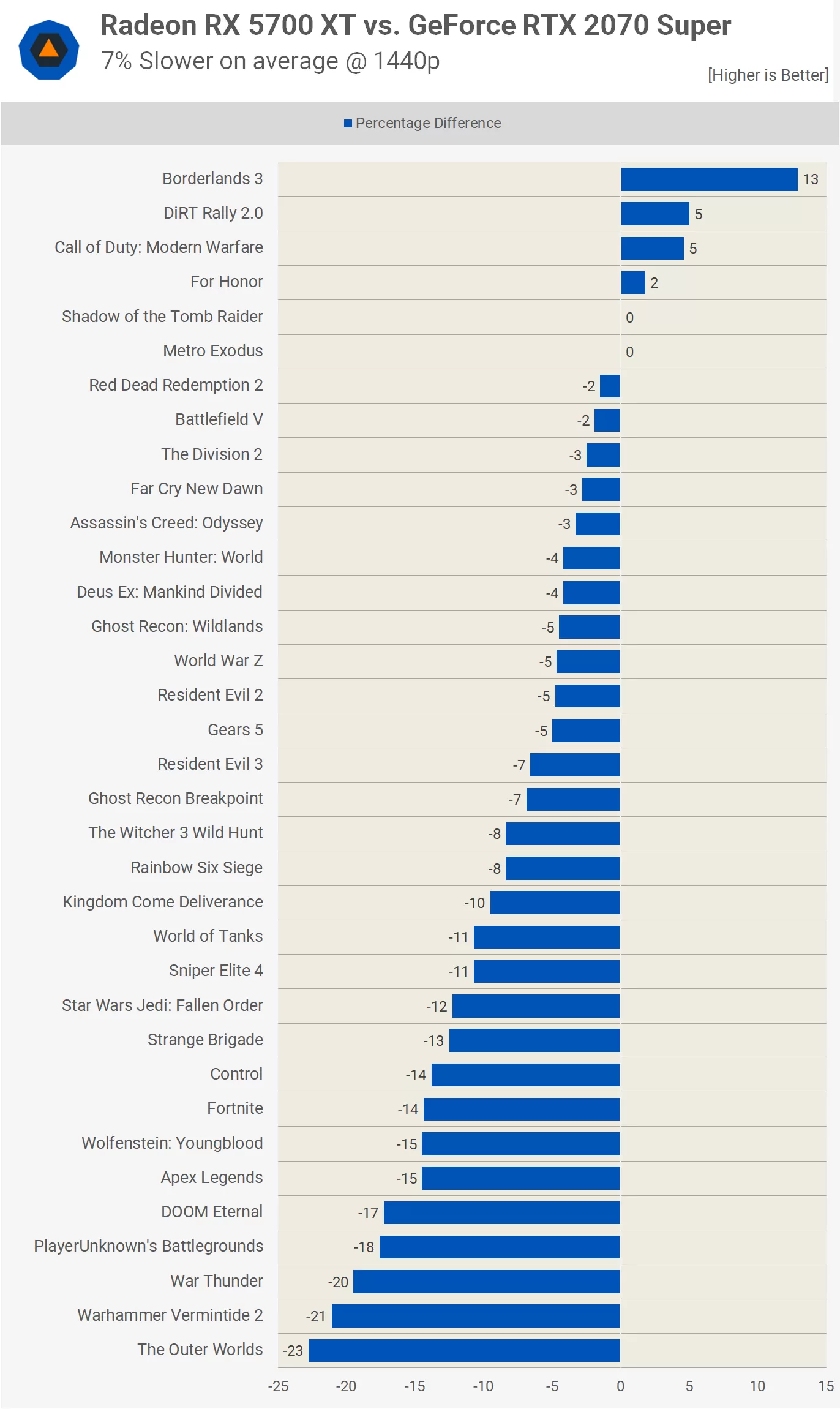
When testing at 1440p the margin is increased by a single percent, so the RTX 2070 is about 7% faster than the 5700 XT. This is basically the same margin we observed between the two GPUs vii months ago when we commencement tested them in a comparing review. In that location'due south been some changes to the games used for testing and the margins in a few titles have inverse, but at the end of the day we finish upwards with a similar result.
But what if we enabled DLSS in Command and Wolfenstein: Youngblood?
DLSS, Anyone?
Enabling DLSS in Command nosotros run across massive gains and please annotation this is the quality DLSS manner as nosotros're running the highest possible DLSS resolution at 1440p.
Frame rates for the 2070 Super were improved by 66% and 60% for the 2060 Super. This means the 2060 Super is at present 48% faster than the 5700 XT while the 2070 Super is an obscene 93% faster.

Taking into account we're talking about comparable image quality betwixt the 5700 XT and 2070 Super using DLSS, this is a devastating event for the Radeon. The only problem for Nvidia and current RTX owners is that for at present, a mere 4 games back up DLSS 2.0.

We too tested Wolfenstein: Youngblood and hither DLSS has far less touch on performance. This may be because frame rates were already very loftier to begin with. DLSS ii.0 still takes a certain amount of fourth dimension to compute and this creates a fleck of a bottleneck for college-end GPUs, or in games that don't require loads of rendering power such as Youngblood.

That'southward not to say we didn't see a performance uplift. The 2070 Super saw a 17% spring and given we're not seeing any noticeable reduction in image quality -- under close scrutiny nosotros'd say it's exactly the same -- this is a big win for DLSS.
The RTX 2060 Super was slower than the 5700 XT without DLSS, enabling it in this game allows the GeForce GPU to take the lead past a 15% margin. The 2070 Super is now also 37% faster, in a disarming win for the greenish team with DLSS enabled.

Taking into account those big DLSS-enabled gains in Wolfenstein and Control, the 5700 XT is now 9% slower on boilerplate at 1440p when compared to the RTX 2070 Super.
Evidently, for DLSS to cripple AMD and have a more than meaningful impact for RTX owners, Nvidia needs to drastically better game support. We're non sure when and if that'south going to happen, but for now it's an impressive engineering that works well in the few games nosotros've tested.
What We Learned
Nvidia has done a great job of reinventing what DLSS is and how it works. They have without question come a long mode from those horribly blurry initial implementations, then kudos to them. The problem is now game back up, we need a lot more of it, simply nosotros believe you'll only see DLSS support in Nvidia sponsored titles (Nvidia GameWorks) and if that is the instance, non enough games volition see DLSS support. The fact that AMD is powering next-gen consoles from Sony and Microsoft is not an encouraging sign either, but we'll just have to expect and see.

When looking at today'south pricing, the GeForce costs 25% more with well-nigh cards on retail starting around $520 and up, while we could also find plenty of 5700 XT's available around the $400 MSRP or slightly in a higher place it for the better equipped models, which we fully recommend.
In terms of value, the 2070 Super tin't reach the levels of the Radeon 5700 XT. But if you prioritize performance then the Nvidia GPU can be the improve choice. For those of you wanting to game at 4K in particular, the 2070 Super is worth spending the extra $100, as the 9% boost information technology offers on boilerplate does typically translate into a better gaming experience.

Bottom line, while we recollect the 5700 XT is somewhat of an obvious choice when compared to the similarly priced 2060 Super, the right choice is less obvious when comparing with the RTX 2070 Super. For well-nigh gamers targeting 1080p or 1440p the Radeon RX 5700 XT offers the best value, but if you're seeking maximum operation at 1440p or across, and then the 2070 Super might be worth spending a fiddling extra on. Either way you can't become wrong as both GPUs deliver exceptional functioning.
Shopping Shortcuts:
- GeForce RTX 2070 Super on Amazon
- Radeon RX 5700 XT on Amazon
- Radeon RX 5700 on Amazon
- GeForce RTX 2080 Super on Amazon
- GeForce RTX 2080 Ti on Amazon
- AMD Ryzen ix 3900X on Amazon
- AMD Ryzen 5 3600 on Amazon

Source: https://www.techspot.com/review/2015-geforce-rtx-2070-super-vs-radeon-5700-xt/
Posted by: loganthreare.blogspot.com
0 Response to "Nvidia GeForce RTX 2070 Super vs. AMD Radeon RX 5700 XT: 2022 Update"
Post a Comment